
四、性能压测与容量规划实战:从Locust脚本到容量预估
性能压测的实际落地往往比预想更为复杂。以下是一个基于Locust的实战脚本,完整模拟了用户从登录到下单的整个行为链路——这真实反映了线上流量的典型模式。
# locustfile.py - 基于Locust的性能压测脚本
from locust import HttpUser, task, between, events
import random
import json

class OrderUser(HttpUser):
    """模拟真实用户的操作行为"""
    wait_time = between(0.5, 2)  # 思考时间0.5-2秒

    def on_start(self):
        """用户启动时自动执行登录"""
        # 执行登录并获取认证Token
        response = self.client.post("/api/auth/login", json={
            "username": f"user_{random.randint(1, 10000)}",
            "password": "test123"
        })
        self.token = response.json().get("token")
        self.headers = {"Authorization": f"Bearer {self.token}"}

    @task(3)  # 任务权重为3
    def view_products(self):
        """浏览商品列表"""
        self.client.get("/api/products", headers=self.headers)

    @task(2)
    def add_to_cart(self):
        """将商品加入购物车"""
        product_id = random.randint(1, 1000)
        self.client.post(f"/api/cart/items", json={
            "product_id": product_id,
            "quantity": 1
        }, headers=self.headers)

    @task(1)
    def checkout(self):
        """提交订单完成购买"""
        self.client.post("/api/orders", json={
            "shipping_address": "Test Address"
        }, headers=self.headers)

# 运行压测
# locust -f locustfile.py --host=https://api.example.com --users=1000 --spawn-rate=10
当然,仅靠模拟测试仍不足够,容量规划的数学模型同样关键。下面这个容量规划器,全面整合了日常流量、峰值系数、数据库连接数以及缓存容量等核心指标——你可以直接使用它进行双十一等大促场景的容量预估。
class CapacityPlanner:
    """系统容量规划工具类"""

    @staticmethod
    def calculate_qps_required(daily_requests, peak_factor=3):
        """计算系统所需峰值QPS
        daily_requests: 每日总请求量(次)
        peak_factor: 峰值倍数(高峰相对于平峰的倍数)
        """
        # 遵循二八原则:80%的请求集中在20%的时间窗口内
        peak_seconds = 24 * 3600 * 0.2  # 对应4.8小时
        peak_qps = (daily_requests * 0.8) / peak_seconds
        return peak_qps * peak_factor

    @staticmethod
    def calculate_servers_needed(peak_qps, single_server_qps, safety_factor=1.5):
        """计算所需最小服务器台数"""
        return math.ceil((peak_qps / single_server_qps) * safety_factor)

    @staticmethod
    def calculate_db_connections(qps, a vg_query_time_ms, connection_pool_size):
        """估算数据库连接池所需连接数"""
        # 每个请求持有连接的时间 = 平均查询时间 * (1 + 等待因子)
        a vg_hold_time = a vg_query_time_ms / 1000 * 1.2
        # 所需连接数 = QPS × 平均持有时间
        required = qps * a vg_hold_time
        return max(required, connection_pool_size)

    @staticmethod
    def calculate_cache_size(daily_active_users, a vg_data_per_user_kb):
        """计算缓存所需容量(单位KB)"""
        # 按二八法则缓存热点数据:20%的用户产生80%的请求
        hot_users = daily_active_users * 0.2
        return hot_users * a vg_data_per_user_kb

# 双十一容量规划示例
daily_requests = 100_000_000  # 每日总请求量1亿次
peak_qps = CapacityPlanner.calculate_qps_required(daily_requests, peak_factor=2)
print(f"峰值QPS: {peak_qps:.0f}")  # 估算峰值QPS约46,296
servers = CapacityPlanner.calculate_servers_needed(peak_qps, 1000, 1.5)
print(f"需要服务器: {servers} 台")  # 需要约70台服务器
五、总结与优化优先级矩阵
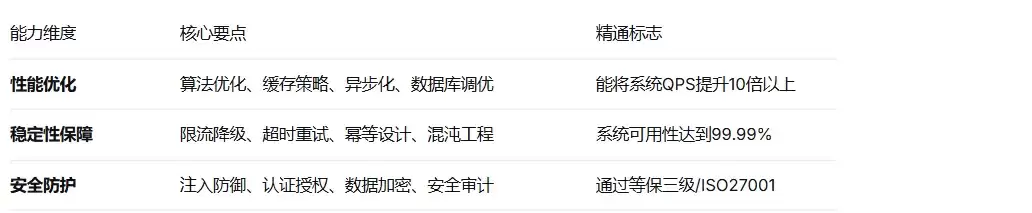
5.1 核心能力图谱
5.2 优化优先级矩阵
                影响范围小        大
          ┌─────────────┬─────────────┐
      高  │  立即处理    │  最高优先   │
          │  代码级优化  │  架构级优化  │
复        ├─────────────┼─────────────┤
杂        │  低优先级   │  计划处理   │
度    低  │  配置调优   │ 基础设施升级 │
          └─────────────┴─────────────┘
性能、稳定性与安全性,是系统得以稳健运行的三大支柱,缺一不可。优秀的工程师不仅能够确保功能正确实现,更能将系统打磨得“更好”。坚持持续优化与不断改进,让每一行代码都发挥最大价值。


